

5 Research-Backed Benefits of Shatavari
Key Takeaways
- Female Reproductive Support: Shatavari is traditionally used to nourish artava dhatu and women’s reproductive wellness; early research suggests phytoestrogens and hormone-pathway activity may support healthy function across life stages.
- Menstrual Cycle Balance: Ayurveda uses shatavari’s cooling, grounding, and demulcent qualities to balance vata and pitta influences; studies using standardized root extract observed improved menstrual health markers and comfort.
- Adaptogenic Stress Resilience: As an herbal adaptogen with antioxidants, shatavari may support calm nerves, steady energy, mood, and sleep; research reports secondary improvements in emotional well-being and sleep quality.
Shatavari (Asparagus racemosus) is a well-known Ayurvedic herb with a long history of use. An herbal adaptogen with naturally occurring antioxidants, shatavari is beneficial in helping the body cope with stress, grounding the nervous system, and supporting healthy, balanced energy levels.
However, shatavari root is best known in Ayurveda as the quintessential herb for the female reproductive system.
A powerhouse herb all on its own, shatavari is also the star herb in all of our women’s formulas, including Women’s Support, Peak Desire for Her, and Women’s Natural Transition—and for good reason.
Shatavari is renowned in Ayurveda for its ability to support women of all ages and phases of life—from those just starting their menstrual cycle all the way through menopause and beyond.
These benefits are gaining attention in the world of research as well, with an increasing number of studies that explore what shatavari does. While more scientific research is needed to better understand all that shatavari has to offer, results are beginning to validate what Ayurvedic practitioners have long known about shatavari.
This article explores the intersection of shatavari’s benefits from both a traditional Ayurvedic perspective and a scientific approach, specifically focusing on shatavari’s support in five key areas:
- Female reproductive system
- Menstrual cycle
- Libido and sexual wellness
- Perimenopause and menopause
- Its adaptogenic benefits

1. Shatavari Promotes Overall Reproductive Wellness
In Ayurveda, the reproductive system can be understood through artava dhatu. Artava dhatu is connected to the reproductive organs and the reproductive system as a whole. This dhatu is linked to the ability to procreate, but it does much more than that.
Artava dhatu is interconnected with our creative juices and ability to create anything we desire. Ojas—the super-fine essence that gives the body strength, vigor, vitality, and immunity—comes from the reproductive layer. In other words, artava is integral to much more than fertility and pregnancy.
Shatavari is the foremost herb in the Ayurvedic pharmacopeia for supporting artava dhatu. Considered a rasayana, or nourishing tonic, shatavari is often used on its own and in formulas to support all facets of the female reproductive system.
What the Research Says
- A 2011 review published in the International Journal of Pharmaceutical & Biological Archives stated shatavari is indeed a versatile female tonic, and cites its phytoestrogen content as a possible contributor to its ability to support so many different facets of a healthy female reproductive system at different phases of life.1
- A 2025 exploratory study published in the International Journal of Women’s Health, which used standardized shatavari root extract, suggests it may influence hormonal pathways (including estrogen and testosterone) and improved sexual function. While larger, more long-term studies are needed to determine the clinical significance, these preliminary findings are promising.2
2. Shatavari Supports a Healthy Menstrual Cycle
In Ayurveda, the menstrual cycle is interconnected to many different parts of the body, including the reproductive organs, rasa dhatu (plasma), rakta dhatu (blood), and of course the doshas, each of which governs a stage of the cycle.
Many of the monthly cycle experiences we deem normal in our culture are actually considered dosha imbalances in Ayurveda—from feeling more irritable beforehand (pitta) to irregular or scanty flow (vata).
Shatavari is an excellent ally for bringing balance to the cycle, especially when excess vata and pitta get involved. Shatavari’s nourishing, grounding, and demulcent qualities are excellent for the dry, light, and erratic qualities of a vata cycle, while its cooling and calming properties are perfect for balancing a pitta cycle.
What the Research Says
- A 2025 randomized, double-blind, placebo-controlled study evaluated a standardized Asparagus racemosus root extract in perimenopausal women experiencing hormonal fluctuations. Researchers observed improvements in menstrual health parameters, along with favorable changes in hormonal markers and reductions in vasomotor symptoms. These findings suggest that shatavari may help support hormonal balance during times when the menstrual cycle becomes less regular, though further research is needed to better understand its role across different life stages.3
- A 2026 study published on PubMed Central examining a standardized shatavari root extract found that it helped alleviate menopausal symptoms across pre-, peri-, and postmenopausal women. Researchers observed improvements in hormone-related symptoms, suggesting that shatavari may help support hormonal balance—a key factor in maintaining a healthy menstrual cycle. While this study focused on menopausal transitions, its findings point to shatavari’s influence on hormonal and endocrine function, as well as its potential influence in supporting a healthy cycle.4

3. Shatavari Helps with Balanced Perimenopause and Menopause Transitions
Perimenopause is the time before menopause, anywhere from a few years to a decade, while menopause is the transition in which the cycle ceases for an extended period of time, at least 12 months.
We’re all likely familiar with the uncomfortable experiences that can arise during these phases, including an increase in dryness that can show up in the hair, skin, and vaginal tissues (all signs of increasing vata) as well as changes in sleep, mood swings, and hot flashes (thanks to excess pitta).
Shatavari once again rises to the challenge. As a deeply nourishing, cooling herbal rejuvenative with an affinity for the female reproductive system, and one that is especially balancing for vata and pitta, shatavari is traditionally used as the go-to herb to help bring balance during this stage of life, and it’s the main herb in our Women’s Natural Transition blend.
What the Research Says
- Citing the same 2025 study from the last section, this study found that a standardized shatavari root extract was associated with improvements in hormonal markers and reductions in vasomotor symptoms, such as hot flashes, in perimenopausal women. Participants also reported improvements in aspects of menstrual health, suggesting that shatavari may help support the body through hormonal fluctuations characteristic of this transition. While more research is needed to confirm long-term effects, these findings offer encouraging evidence for its role in menopausal support.5
- Similarly, the 2026 clinical study from the last section reported reductions in common menopausal symptoms across pre-, peri-, and postmenopausal women. Participants reported improvements in areas such as sleep quality, mood, and overall comfort, pointing to shatavari’s potential to support quality of life during menopause.6
- Earlier research, including a 2013 pharmacological review, highlights shatavari’s rich profile of bioactive compounds, including steroidal saponins (shatavarins), which are thought to contribute to its phytoestrogenic and adaptogenic properties. These compounds may help explain its traditional use in supporting hormonal balance and easing the menopausal transition, though more targeted human studies are still needed.7

4. Shatavari Promotes a Healthy Libido and Sexual Wellness
In Ayurveda, healthy libido and overall sexual wellness are not viewed in isolation, but rather as a reflection of inner vitality.
Shatavari translates as “one hundred husbands,” implying shatavari’s prowess in supporting a healthy intimate life; it has a well-established reputation of supporting a healthy libido and sexual wellness and is considered a vajikarana herb. Vajikarana is an entire classical branch of Ayurveda that focuses on supporting reproductive health, sexual wellness, and vitality.
Shatavari’s many properties come into play here—as a cooling, nourishing tonic, shatavari is connected with softness, lubrication, and replenishment. It is traditionally used when the body feels depleted and to restore moisture and balance within the body.
In Ayurveda, shatavari is also called the Queen of Herbs because of its ability to promote love and devotion.8 From a modern perspective, it helps with stress relief (stress being a main cause of low libido) and fostering connection—both important for intimacy and a healthy sex life.
What the Research Says
- Citing the same 2025 randomized, double-blind, placebo-controlled study from the first section, research found improvements in multiple markers of sexual wellness in women, including desire, arousal, lubrication, and overall satisfaction. Participants in the treatment group also showed improvements in related areas such as mood and overall well-being. Interestingly, when combined with ashwagandha root extract, results showed a trend toward greater overall improvement.9
5. Shatavari Fosters Healthy Energy Levels and Stress Resilience
Like ashwagandha—a popular adaptogen and the quintessential herb for male reproductive system health—shatavari is a recognized adaptogen. Herbal adaptogens help the body respond and essentially adapt to physical and emotional stress, including healthy energy levels, a calm mind, and more resilience overall.
Adaptogens are also connected to ojas in Ayurveda, that superfine essence that is a result of healthy artava dhatu, and is connected to our vitality.
As an adaptogen, shatavari’s nourishing and rejuvenating qualities are in full force: it helps ground and calm the nervous system, supports a sense of ease, and fosters sustained, balanced energy.
What the Research Says
- Emerging research suggests that shatavari’s benefits may include support for mood and sleep, which are closely associated with stress resilience. In the 2025 randomized controlled trial on sexual wellness mentioned in the last section, participants taking shatavari also reported improvements in secondary outcomes such as sleep quality and emotional well-being—both of which are closely tied to stress resilience and energy regulation.10
- Similarly, the 2026 shatavari extract study mentioned under menstrual wellness observed improvements in sleep quality among participants, an important factor in maintaining healthy energy levels and the body’s ability to recover from stress. Better sleep is strongly associated with improved mood, cognitive function, and overall vitality, suggesting a potential pathway through which shatavari exerts its adaptogenic effects.11
- A 2023 review establishes that, according to prehistoric texts and progressive pharmacological studies, Asparagus racemosus has various phyto-pharmaceutical properties, including neuroprotective, nootropic, antioxidant, and adaptogenic effects.12
Whole Shatavari Root vs. Shatavari Extract
It’s important to note that most modern clinical trials use standardized extracts to ensure consistent dosing. In particular, shatavari extracts typically standardize its steroidal saponins, known as shatavarins, which are tied to shatavari’s adaptogenic properties. While standardizing ensures consistency in research, it does remove the full spectrum of a plant’s naturally occurring compounds. For example, shatavari root also includes:
- Antioxidants
- Flavonoids and polyphenals
- Phytoestrogens
- Polysaccharides
- Flavonoids
- Trace minerals
- Tryptophan
These compounds may contribute to the efficacy and activity of an herb, which is a common argument in botanical medicine. This idea is often described as the “entourage effect” or “phytochemical synergy.” In this view, all components of an herb play a role in its overall effect on the physiology.
This certainly aligns with the traditional Ayurvedic approach to use the whole shatavari root powder, which contains all the plant has to offer.
In other words, scientific studies that use root extract don’t match the traditional form of shatavari, and they may not capture the full benefits of the herb. In fact, some of these studies even called out the limitations of focusing on one standardized constituent.
Furthermore, in Ayurvedic herbalism, shatavari is often used in formulations with multiple herbs, making it difficult to fully compare traditional use and benefits with these studies.
In Summary
We’re not quite at the point of comparing apples to apples when it comes to reviewing current research and shatavari’s traditional Ayurvedic use. There is still plenty of research to do to better understand shatavari, especially when it is used in its whole form.
Even so, these studies offer a compelling initial glimpse into understanding shatavari through the lens of modern research, while they also start to show what Ayurveda has long known about shatavari—that it is a key herbal ally in supporting overall women’s health.

More for You
Why a Healthy Cycle Is So Important
What is your period trying to tell you? According to Ayurveda, tuning into the nature of your cycle each month can help you gain a better understanding of your overall health. Read this article to learn more about healthy cycles and how you can balance yours with the help of Ayurveda.
References
1Sharma, komal. “Asparagus Racemosus (Shatavari): A Versatile Female Tonic.” International Journal of Pharmaceutical & Biological Archives, 2011. https://www.academia.edu/73279557/Asparagus_racemosus_Shatavari_A_Versatile_Female_Tonic.
2Ademola J, Mahajan S, Srivathsan M, Langade D. Effects of Shatavari (Asparagus racemosus) Root Extract on Sexual Wellness in Women: Findings from a Prospective, Randomized, Double-Blind, Three-Arm, Parallel-Group, Placebo-Controlled Study. Int J Womens Health. 2026;18:561213. https://doi.org/10.2147/IJWH.S561213.
3Kumar, S., et al. (2025). A Standardized Asparagus Racemosus Root Extract Improves Hormonal Balance and Menstrual Health and Reduces Vasomotor Symptoms in Perimenopausal Women: A Randomized, Double-Blind, Placebo-Controlled Study. PubMed, 40434025. https://pubmed.ncbi.nlm.nih.gov/40434025/.
4Swaroop, Ananya, and Anand Swaroop. “Asparagus racemosus Root Extract (SheVari4®) Alleviates Menopausal Symptoms in Pre-, Peri-, and Post-menopausal Healthy Women.” Cureus vol. 18,4 e106987. 13 Apr. 2026. pmc.ncbi.nlm.nih.gov/articles/PMC13076000/.
5Kumar et al.
6Swaroop, Ananya, and Anand Swaroop (2026).
7Alok, S., et al. (2013). Plant profile, phytochemistry and pharmacology of Asparagus racemosus (Shatavari): A review. Asian Pacific Journal of Tropical Disease, 3(3), 242–251. https://pmc.ncbi.nlm.nih.gov/articles/PMC4027291/.
8Alok et al.
9Ademola et al.
10Ibid.
11Swaroop, Ananya, and Anand Swaroop (2026).
12Singh, N., Garg, M., Prajapati, P., Singh, P. K., Chopra, R., Kumari, A., & Mittal, A. (2023). Adaptogenic property of Asparagus racemosus: Future trends and prospects. Heliyon, 9(4), e14932. https://doi.org/10.1016/j.heliyon.2023.e14932.
Related Products
-
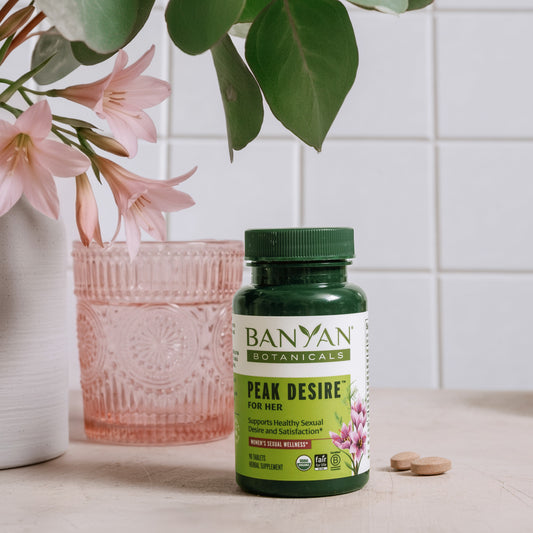
Peak Desire™ for Her
Supports healthy sexual desire, improved satisfaction, and overall sexual wellness*
Regular price $26.99Sale price $26.99 Regular priceUnit price per -

 Most Subscribed
Women's Natural Transition™ tablets
With herbs that traditionally soothe occasional hot flashes and support a healthy menopause*
Regular price $27.99Sale price $27.99 Regular priceUnit price per -
Women's Support™ tablets
Revitalizing herbs traditionally used to support balanced hormones, a healthy cycle, and beyond*
Regular price $25.99Sale price $25.99 Regular priceUnit price per -
Shatavari tablets
Adaptogen traditionally used to support all facets of a healthy female reproductive system*
Regular price $24.99Sale price $24.99 Regular priceUnit price per





Your cart (0 items)
Get Started With These Products:
-
 Peaceful Mood Bundle$62.09
$68.98Regular priceSale price $68.98 Regular priceUnit price per -
 Oral Health Bundle$37.78
$41.97Regular priceSale price $41.97 Regular priceUnit price per -
 Glowing Face and Body Bundle$88.20
$98.00Regular priceSale price $98.00 Regular priceUnit price per -
 Hair Gloss & Growth Bundle$78.28
$86.97Regular priceSale price $86.97 Regular priceUnit price per


- Choosing a selection results in a full page refresh.
- Opens in a new window.