An Ayurvedic Guide to Healthy Libido and Sexual Wellness
We speak openly about sleep, digestion, mental health, and energy levels as reflections of our health. But when it comes to libido, the conversation often becomes hesitant—sometimes avoided altogether. It can feel like something personal, even uncomfortable to name, rather than what it truly is: a natural function of the body.
Libido is no different from any other physiological rhythm. Like hunger, like rest, like emotions, it shifts in response to how we are living, how we are feeling, and how well we are supported. And yet, for many people, changes in sexual desire are internalized as something to fix, question, or quietly carry.
But what if we approached it differently—not as a problem, but as information?
From an Ayurvedic perspective, libido is not a standalone function—it is a reflection of how well the body, mind, and energy systems are working together. When you feel nourished, rested, and connected, desire tends to arise naturally. When stress accumulates, sleep is disrupted, or emotional bandwidth is stretched, libido naturally shifts in response.
This understanding allows for a more compassionate, grounded approach to sexual wellness—one that moves away from performance and toward balance.
Ultimately, libido is not something to be forced or judged. It is a natural expression of how you feel within yourself—and it deserves to be understood with the same openness and ease as any other aspect of health.
In This Article:
- What Is Libido?
- Ayurveda and Sexual Wellness
- Why Sexual Wellness Matters for Overall Health
- Ayurvedic Practices to Support Sexual Wellness
- Herbal Support for Sexual Wellness
- FAQs

What Is Libido?
Libido refers to sexual desire or interest. It is not the same as sexual performance, physical ability, or even physical response (or arousal). All are connected to overall sexual wellness.
- Desire (libido) is psychological and emotional. It includes interest, curiosity, attraction, and willingness for intimacy.
- Arousal is physiological. It involves the body’s response—such as lubrication, erection, increased sensitivity, and blood flow.1
In modern terms, libido is often discussed and addressed as a standalone function of sexual wellness. It also comes with plenty of cultural baggage and misconceptions around what a healthy sex drive is “supposed” to look like. For three common myths: males have a higher sex drive than females, desire has to be spontaneous to be healthy, and a fluctuating or sometimes low libido indicates a problem.2
These myths are unhelpful at best, and they can leave a person feeling disappointed and even ashamed of themselves—as if there’s something wrong with them that needs to be fixed.
However, contrary to popular myth, both modern physiology and Ayurveda agree that sexual desire is unique to every individual—regardless of gender. As a reflection of overall vitality, libido naturally rises and falls. When the body is resourced, desire tends to emerge. When the system is depleted or overloaded, libido often decreases.

Ayurveda and Sexual Wellness
Ayurveda invites a more expansive understanding of sexual wellness—one that moves beyond the narrow definitions often presented in modern discourse.
It is not measured by performance, nor defined by frequency or intensity. It is not something that can be forced, stimulated on demand, or sustained through sheer will. Desire, in this tradition, is not something to extract from the body—it is something that arises when the body feels nourished, rested, and at ease.
Sexual wellness is also not separate from emotional life. It is shaped by how safe you feel, how connected you are—to yourself and to others—and how much space you have to be present. Nor does it exist independently of the body’s foundational rhythms. Digestion, sleep, and stress all play a central role in determining whether desire feels accessible or distant.
In this way, Ayurveda stands in contrast to more reductionist models that attempt to isolate libido as a single function to be optimized. Instead, it understands sexual wellness as an integrated expression of overall vitality—one that reflects the deeper state of balance within the system.
How Ayurveda Defines Sexual Wellness
In Ayurveda, sexual wellness is considered an important part of a healthy life. There is an entire classical branch of Ayurveda focused on supporting reproductive health, sexual wellness, and vitality, called vajikarana.
Some key Ayurvedic concepts include:
- Kama: meaning desire itself—although it is much more than sexual desire or sexual longing, it is the soul’s appetite for life—which includes sensual and emotional longing, and one of the four aims of life in Ayurveda, representing the natural human pursuit of pleasure, connection, and fulfillment.
- Iccha: translates as desire or longing, reflecting the inner impulse toward connection, pleasure, intimacy, or creative expression.
- Shukra and Artava Dhatu: the reproductive organs responsible for fertility, vitality, and sexual function in male and female.
- Vṛṣya: substances or practices that enhance reproductive strength, vitality, and the capacity for healthy sexual function.
- Ojas: the subtle essence of all tissues obtained from whole body nourishment, often associated with resilience and immunity.
From this lens, libido and arousal are not isolated—they reflect the quality of nourishment, energy, and resilience within the body.
Ayurvedically, you can think of desire (iccha) as the mental-emotional impulse, and arousal as the physical expression of healthy shukra and artava dhatu and proper circulation through the channels (srotas).
These two don’t always move together. For example, you may feel mentally interested but physically unresponsive (which may show up as stress or dryness, a vata imbalance, or erectile dysfunction from clogged channels, a kapha issue), or physical arousal may occur without emotional desire.
This disconnect is common—and often rooted in a nervous system state, not dysfunction.

Why Sexual Wellness Matters for Overall Health
By now, we have established that sexual wellness is not separate from overall health—it’s often a reflection of it.
Your level of desire is closely connected to how well your body and mind are functioning. It reflects the state of your nervous system, your circulation, hormones, digestion, sleep quality, and your emotional well-being. When these systems feel supported and balanced, desire tends to arise more naturally. When they’re strained—whether from stress, fatigue, or depletion—libido is often one of the first things to shift.
Common reasons for libido to fluctuate include:
- Stress and mental load
- Hormonal transitions (including menstrual cycle, postpartum, andropause, and menopause)
- Sleep quality
- Emotional health and relationship dynamics
- Medications or health conditions
- Life stage and shifting priorities
Ayurveda frames this simply—when energy is conserved for survival or repair, it is not directed toward pleasure.
Rather than viewing low libido as something to fix, it can be more useful to see it as feedback. It offers insight into how your body is allocating energy and where support may be needed.

The Doshas and Libido
From an Ayurvedic perspective, low libido is rarely random. It reflects underlying shifts in how energy is moving through the body—whether it is depleted, overextended, or stagnant.
Each dosha offers a distinct pattern:
Vata Imbalance is characterized by irregularity and depletion. Your system may feel scattered, dry, or ungrounded, with energy that moves quickly but lacks stability. An example is premature ejaculation, in which the body is quickly aroused and then depleted. In modern terms, this often shows up as constant mental activity, a heightened state of alertness, and difficulty settling into the body. When your system is not anchored, desire may feel inconsistent or difficult to access.
Pitta Imbalance reflects excess intensity and drive. Energy is strong but directed outward—toward productivity, focus, and forward momentum. There may be a sense of internal heat or pressure, with little space for slowing down. In this state, the body remains in a mode of output rather than receptivity, which can make it harder for desire to naturally arise.
Kapha Imbalance is associated with heaviness and stagnation. Energy may feel steady but unmoving, with a tendency toward inertia or dullness. When circulation—both physical and energetic—is reduced, there is less activation within the system. As a result, desire may feel distant or muted, or you may be unable to respond to the desire due to the stagnation.
Across all three patterns, the common thread is this: libido reflects how energy (prana) is organized within the body. When energy is balanced—stable, responsive, and flowing—desire tends to emerge more naturally. Let’s keep these dosha patterns in mind as we explore some of the common reasons that impact libido.

Stress and Libido: The Mind-Body Connection
One of the most common reasons for low libido is chronic stress. Physiologically, the body operates in different modes. When you’re under stress, the system shifts into a state focused on alertness and survival. In contrast, sexual desire depends on a state of relaxation, safety, and presence.3
These two states don’t easily coexist. When the body is busy managing demands, processing pressure, or staying mentally “on,” it naturally deprioritizes desire and intimacy.
Sleep quality is one of the primary ways the body exits that stress state. During deep, restorative sleep, the nervous system resets, hormones are regulated, and energy is replenished. When sleep is disrupted—whether from stress, irregular routines, or overstimulation—the body remains in a more activated state.4
Over time, this can create a subtle disconnection—not just from desire, but from the body itself. Constant stimulation, including work demands and digital overload, makes it harder to slow down, feel, and be present.
Desire doesn’t disappear randomly. It often recedes when the body no longer feels resourced enough to access it.

Digestion, Gut Health, and Libido
In Ayurveda, digestion sits at the center of all vitality—including sexual wellness.
The strength of your digestive fire (agni) determines how well food is broken down, absorbed, and ultimately transformed into energy and nourishment for the body’s tissues (ojas). Sexual vitality is considered one of the most refined expressions of this process.
When digestion is strong, nutrients are efficiently converted into deeper tissue nourishment, including reproductive tissue (shukra and artava dhatu). When digestion is impaired, this process becomes less efficient.
From a modern perspective, gut health also plays a central role in:
- Hormone regulation
- Nutrient absorption
- Inflammation levels
- The gut–brain connection
Imbalances such as bloating, irregular digestion, or chronic gut discomfort can subtly affect energy, mood, and hormonal signaling—all of which influence libido.5
In simple terms: if the body is not well-nourished at a foundational level, it is less likely to prioritize desire.

Intimacy and Emotional Connection
Sexual wellness is not only physical—it is deeply shaped by how safe, connected, and present you feel.
Emotional safety allows the body to soften. Trust and connection create the conditions where desire can emerge without effort. At the same time, your relationship with yourself—how comfortable you feel in your own body—plays an equally important role.
Rest also matters here. When you are exhausted or mentally overloaded, it becomes much harder to access presence, connection, or sensitivity—regardless of external circumstances.
This is true whether you are in a relationship or not. A sense of ease, embodiment, and self-connection forms the foundation of healthy libido.
A common blind spot is focusing only on external factors—trying to increase desire through stimulation or technique—without addressing the internal experience. Without a sense of presence, safety, and rest, desire often remains out of reach.

Ayurvedic Practices to Support Sexual Wellness Naturally
Sexual wellness is not created through effort, but through rhythm—through the small, repeated ways the body is allowed to soften, restore, and reconnect.
The following list offers some gentle, restorative ways to support your whole self to release stress, ground the nervous system, and come back into your body so you can enjoy a deeper connection to pleasure.
Restorative Practices to Release Stress and Ground the Nervous System
- Practice Pranayama. Begin by creating space for the body to slow down. Slow, steady breathing—such as Nadi Shodhana (alternate nostril breathing)—helps regulate the nervous system and settle internal activity. Paired with calm meditation, it quiets mental noise and brings attention back to the present moment.
- Enjoy Abhyanga. A warm oil massage, practiced alone or shared with a partner, can further ground the body through touch and sensation. Gentle boundaries with screens and constant input allow the system to gradually unwind, creating the conditions where the body can feel at ease again.
- Rebuild with Proper Rest. Consistent sleep rhythms help regulate energy over time, while evenings that gradually soften—less light, less stimulation—support this transition inward. Deep, uninterrupted sleep replenishes the reserves that vitality and desire depend on.
Desire tends to arise when the body no longer feels rushed.

Nurturing Practices to Care for the Body
- Practice Gentle Exercise. Movement supports flow, but it does not need to be intense. Walking, stretching, or slow yoga can restore circulation and awareness in the body. Postures such as Bridge Pose, Cobra, Bound Angle, and Low Lunge help bring warmth and attention to the pelvic space. When practiced slowly, with breath—or even alongside a partner—they can deepen both connection and sensitivity.
- Support Digestion. Vitality is built from what the body receives consistently. Warm, grounding foods are easier to digest and transform into energy. Healthy fats like ghee support softness and lubrication, while adequate hydration maintains fluidity. Reducing excess stimulants helps prevent energy from being pulled outward.
When the body feels nourished and at ease, vitality gathers quietly—and from that, desire can return.

Focus on Your Environment and Engage the Senses
Your body is responding to your environment, and subtle shifts in your surroundings can begin to change how you feel. Pay attention to what your senses are telling you—how is the lighting? The scent? The sound?
- Soft, warm lighting—such as lamps or candlelight—can help signal the body to slow down.
- Calming scents like sandalwood, rose, jasmine, or lavender, whether through oils or fresh flowers, can gently open the senses and create a feeling of ease.
- Sound also plays a role. Soft instrumental music, nature sounds, or gentle mantras in the background can provide a steady, grounding rhythm that quiets mental activity. Even the absence of noise—creating a space that feels undisturbed—can be deeply regulating.
Together, these sensory cues—what you see, smell, and hear—can communicate safety to the body and calm the mind, while they can also help cultivate a sense of love, connection, juiciness, and passion.

Step into Greater Presence and Awareness
Desire is closely tied to attention. A slower pace, a lingering moment, or a sustained gaze can shift how the body experiences connection. Touch becomes exploratory rather than goal-oriented. Releasing the need to perform allows sensation to unfold more naturally.
Tuning into your body is a wonderful way to bring your awareness to the present moment. Take time to pay attention to each sense—the sensation on your skin, what you hear, what you see—so you can enjoy a truly sensual experience.
Desire is often less about doing, and more about feeling.

Ayurvedic Herbs to Support Sexual Wellness
In Ayurveda, herbs are used to restore the body’s natural functions in which desire can arise. They support how the body adapts to stress, how energy is built, and how nourishment reaches deeper tissues.
Rather than acting in isolation, these herbs work throughout the body—supporting resilience, circulation, and the refinement of energy into shukra and artava dhatu, the tissues associated with reproductive vitality.
When these herbs are taken in tandem with supportive lifestyle practices, the whole body is nourished and desire is allowed to flourish.
Ayurvedic Blends:
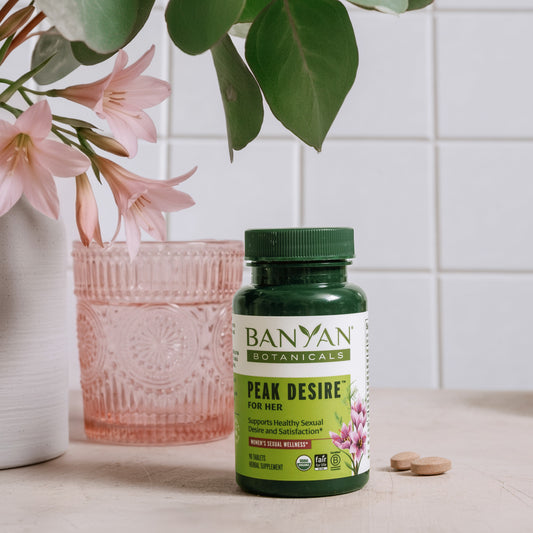
Peak Desire for Her. This herbal blend gets to the root of healthy sexual desire for women.
Blending 11 key herbs, including shatavari, vidari kanda, and saffron, Peak Desire for Her helps relieve stress, support relaxation, and helps foster healthy desire. These tablets also go beyond just desire, supporting improved satisfaction and a healthy, pleasurable sex life overall.
Benefits build over time, so staying consistent and incorporating these tablets in your daily self-care routine is key.
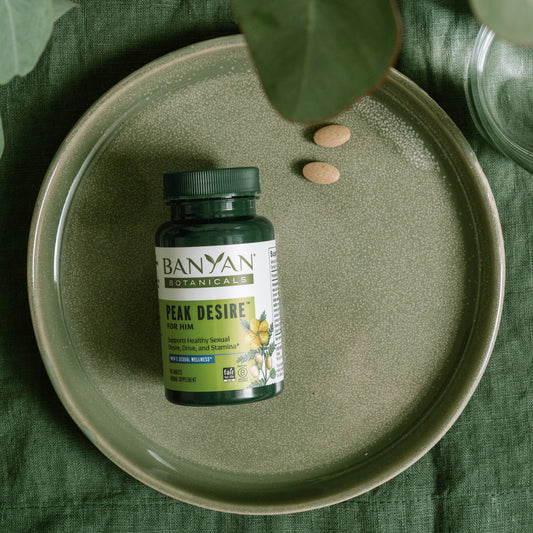
Peak Desire for Him. Peak Desire for Him blends 13 key ingredients, such as ashwagandha, mucuna, and shilajit, to support healthy sexual desire and arousal, including healthy erectile function and enhanced stamina for overall sexual wellness.
Take these tablets daily as a part of your self-care routine for best results.
Single Herbs:
Ashwagandha (Withania somnifera). A grounding, restorative herb traditionally used to rebuild strength and steadiness. Ashwagandha supports the body’s ability to adapt to stress while gently replenishing energy reserves. When the system feels less depleted and more anchored, desire often becomes more accessible.6
Often suited for those feeling overextended, mentally active, or energetically drained.
Shatavari (Asparagus racemosus). A deeply nourishing herb associated with softness, lubrication, and replenishment.
Shatavari is traditionally used to support reproductive tissues and restore moisture and balance within the body. It is especially valued during times of transition, when the system may feel dry or depleted.
Often supportive when there is a need for gentle rebuilding and internal nourishment.
Gokshura (Tribulus) (Tribulus terrestris). A stabilizing herb that supports flow and balance within the system.
Gokshura has traditionally been used to support both urinary and reproductive pathways, helping maintain ease and continuity in how energy and fluids move through the body.
Often chosen when there is a need to support steady vitality and circulation.
Mucuna (Kapikacchu) (Mucuna pruriens). An uplifting, enlivening herb that supports mood and inner drive.
Mucuna is traditionally associated with motivation, emotional brightness, and engagement. When energy feels flat or disconnected, it can help rekindle a sense of responsiveness.
Often supportive when desire feels distant due to low engagement or internal dullness.
Shilajit. A deeply mineral-rich substance associated with endurance and long-term vitality.
Shilajit is traditionally used to support strength, stamina, and the body’s ability to sustain energy over time. It works more gradually, building depth rather than quick stimulation.
Often suited for those experiencing long-standing depletion.
Saffron (Crocus sativus). A subtle, sensory herb associated with mood, warmth, and emotional openness.
Saffron has long been used to support emotional balance and enhance the experience of pleasure through the senses. It brings a lightness that can help shift the internal environment.7
Often supportive when desire is influenced by mood or emotional heaviness.
Fenugreek (Trigonella foenum-graecum). A warming, nourishing herb that supports metabolic and reproductive balance.
Fenugreek has traditionally been used to support internal warmth and nourishment, helping the body maintain steady energy and fluid balance.
Often chosen when there is a need to support foundational nourishment and internal rhythm.
Gotu Kola (Brahmi) (Centella asiatica). A nervine herb that supports mental calm and gentle awareness.
Gotu Kola is traditionally used to support the nervous system and cognitive clarity. By quieting excess mental activity, it can help restore a sense of presence within the body.
Often supportive when the mind feels overactive and disconnected from physical sensation.
Frequently Asked Questions
What causes low libido?
Low libido can be influenced by a combination of factors, including stress, poor sleep quality, hormonal shifts, digestive imbalance, and emotional disconnection. Rather than a single cause, it often reflects how the body is allocating energy. When the system feels depleted or overwhelmed, desire naturally takes a lower priority. In this way, low libido is often a signal of imbalance rather than a standalone issue.
Can stress reduce sexual desire?
Yes, stress is one of the most common contributors to low libido. When the body is in a heightened state of alertness, it prioritizes survival and productivity over intimacy. Sexual desire depends on a more relaxed, parasympathetic state. Without that sense of safety and ease, desire becomes less accessible.
What herbs for sexual wellness does Ayurveda have?
Ayurveda includes a category of herbs traditionally used to support reproductive vitality and sexual wellness. These herbs work by nourishing the body, supporting resilience, and enhancing overall vitality. Rather than targeting desire directly, they help create the internal conditions that support it. They are most effective when combined with supportive lifestyle practices. Explore Banyan's herbs and products for sexual wellness.
How long does it take herbs to support libido?
Herbs typically work gradually by supporting the body’s underlying systems rather than creating immediate effects. With consistent use, shifts may be noticed anywhere from a week to a few weeks as energy, resilience, and overall balance improve. The timeline can vary depending on the individual and the root cause of imbalance. A steady, supportive approach tends to be most effective.
Can you take libido herbs daily?
Many Ayurvedic herbs are traditionally used on a regular, ongoing basis to build strength and balance over time. Daily use can be appropriate when aligned with individual needs and overall constitution. However, consistency and proper selection matter more than frequency alone. It’s best to approach herbal use as part of a broader, supportive routine.
Can libido improve naturally?
Yes, libido can often improve naturally when foundational areas of health are supported. This includes sleep, digestion, stress regulation, and emotional well-being. As the body becomes more balanced and nourished, desire tends to return without forcing it. The focus is less on “increasing” libido and more on restoring the conditions that allow it to arise.
Is libido experienced the same across all genders?
No, libido is not necessarily experienced the same across all genders. Large scale research has proven that, on average, men do have a higher libido than women.8 However, women can also have a high libido, just as some men may typically have a lower libido. Regardless of gender, anyone can experience fluctuations due to dosha imbalances and lifestyle factors, including stress levels, quality of sleep, and hormonal shifts.
Is low libido normal during menopause?
Yes, changes in libido are common during menopause due to natural shifts in the body’s rhythms and energy patterns.9 These changes can influence how desire is experienced, but they do not mean it disappears entirely. With supportive lifestyle practices and nourishment, many people continue to experience fulfilling sexual wellness. It simply may look different than before.
When is it best to seek professional support for low libido or arousal?
While it is normal for libido, arousal, and sexual function to fluctuate, there are times when it’s best to seek professional support. If you’re experiencing persistent pain, sudden and drastic libido changes, or severe erectile dysfunction, or if you have hormonal concerns or emotional distress, we recommend working with a trained health practitioner to offer you deeper support.
About the Author


More for You
An Introduction to Pranayama
Have you ever noticed how often we use the word “breath” in our daily live? We use phrases like, “I’m not going to hold my breath,” “Like a breath of fresh air,” “I have to catch my breath,” “It took my breath away,” “Take a deep breath first,” and so forth. Pranayama is a yogic practice commonly translated as “control of the breath.”
Cultivating Ojas with Ayurveda
In the Ayurvedic tradition, ojas has everything to do with immunity. Because it is the superfine essence of kapha, it shares desirable qualities of this dosha, such as strength, nourishment, steadiness.
References
1 Calabrò, Rocco S., Alberto Cacciola, Daniele Bruschetta, Demetrio Milardi, Fabrizio Quattrini, Francesca Sciarrone, Gianluca La Rosa, Placido Bramanti, and Giuseppe Anastasi. “Neuroanatomy and Function of Human Sexual Behavior: A Neglected or Unknown Issue?” Brain and Behavior 9, no. 12 (2019): e01389. https://doi.org/10.1002/brb3.1389
2 Pfaus, James G. “Pathways of Sexual Desire.” The Journal of Sexual Medicine 12, no. 7 (2015): 1506–33. https://doi.org/10.1111/jsm.12894.
3 Calabrò et al., “Neuroanatomy and Function of Human Sexual Behavior,” e01389.
4 Georgiadis, Jan R., and Stephanie A. Holstege. “Human Brain Activation during Sexual Stimulation of the Penis.” Neuroscience Letters 569 (2014): 64–68. https://doi.org/10.1016/j.neulet.2011.10.047.
5 Fuchs, Yoram, et al. “Effects of Aerobic Exercise on Core Executive Function in Adults with Major Depressive Disorder: A Systematic Review and Three-Level Meta-Analysis.” Psychiatry Research 345 (2026): 116550. https://doi.org/10.1016/j.psychres.2024.116550.
6 Liu, Xiaoyan, et al. “Pleasure Is Diverse: Women’s Experiences of Solo and Partnered Sexual Pleasure in China.” BMC Women’s Health 24, no. 1 (2024): 398. https://doi.org/10.1186/s12905-024-02980-w
7 Frankenbach, Julia, et al. “Towards a Balanced Conceptualization of Solitary and Partnered Sexual Pleasure.” Current Sexual Health Reports 14 (2022): 141–50. https://gwern.net/doc/psychology/personality/2022-frankenbach.pdf
8Cera, Nicoletta, et al. “How Relevant Is the Systemic Oxytocin Concentration for Human Sexual Behavior? A Systematic Review.” Sexual Medicine Reviews 8, no. 4 (2020): 638–50. https://doi.org/10.1016/j.sxmr.2019.09.001
9Stulhofer, Aleksandar, et al. “The Relative Importance of Sexual Motives, Pleasure, and Emotional Intimacy in Sexual Satisfaction.” Archives of Sexual Behavior 48, no. 2 (2019): 539–52. https://doi.org/10.1007/s10508-018-1313-7.